
Blog Posts
Signs of Meth Addiction You Shouldn’t Miss
Apr
Someone can look “fine” for a while and still be slipping hard into dependence. That is part of what makes the signs of meth addiction easy to miss at first. The shift often starts with more energy, less sleep, more talk, and bigger swings in mood, then turns into something harder to hide once the crashes, paranoia, and physical decline start showing up.
Meth changes behavior fast, but not always in the same way for every person. Some people become intensely productive for short bursts. Others get reckless, secretive, aggressive, or emotionally flat. If you are trying to figure out whether use has crossed into addiction, the clearest answer usually comes from the pattern, not one isolated symptom.
What the signs of meth addiction usually look like
A lot of people expect addiction to look dramatic right away. Sometimes it does. Sometimes it looks more like a person staying awake all night, losing weight, talking faster than usual, and becoming oddly fixated on tasks, money, sex, or getting more product. That early phase can be mistaken for stress, partying, overwork, or a rough patch.
The bigger red flag is repetition. When meth use keeps showing up despite obvious damage to work, relationships, health, or judgment, that is no longer casual use. It suggests the drug is starting to run the schedule.
You will often see a mix of physical, psychological, and lifestyle changes happening at the same time. One sign on its own does not prove addiction. Several signs stacking up over weeks or months is a different story.
Physical changes that stand out
One of the fastest visible shifts is sleep disruption. A person may stay awake for long stretches, barely eat, and then disappear into a heavy crash. This cycle can repeat again and again. Over time, it tends to show on the body.
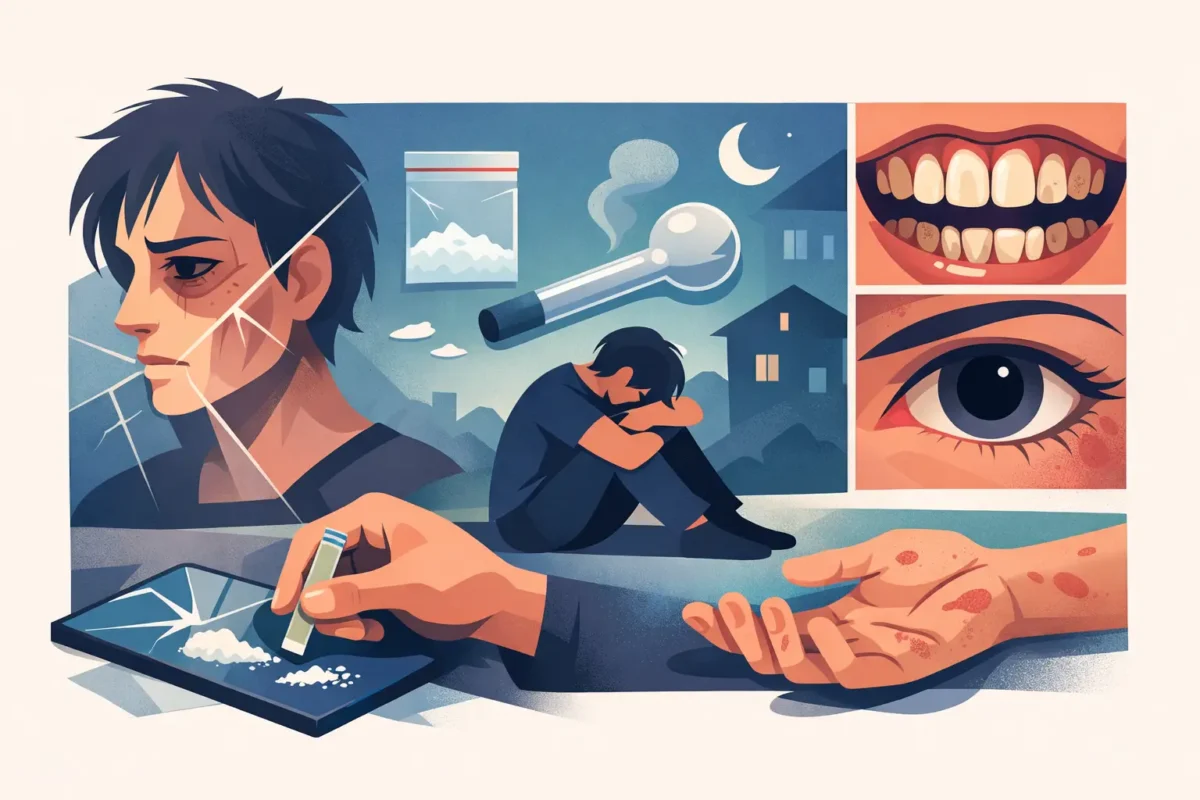
Weight loss is common because meth can suppress appetite for extended periods. Skin may start to look dull or irritated. Some people pick at their skin, especially when anxiety, paranoia, or tactile hallucinations set in. Dental decline can also become more noticeable, though that usually develops over time rather than overnight.
You may also notice enlarged pupils, jaw clenching, repetitive movements, sweating, twitching, or a wired physical intensity that feels off even when the person claims they are okay. The body can look overstimulated for hours, then completely drained afterward.
Behavioral signs that get harder to hide
Behavior usually tells the story before a person admits anything. Secretiveness is common. So is disappearing for long periods, changing routines, ignoring responsibilities, and becoming unusually defensive when questioned.
Money problems can start showing up fast. Meth addiction often brings impulsive spending, borrowing, selling belongings, or sudden explanations that do not quite add up. Someone may also become fixated on finding, using, or recovering from the drug, even if they insist they are still in control.
Another common sign is a sharp change in priorities. Work, parenting, hygiene, relationships, and basic daily tasks start slipping. The person may still make promises, but follow-through gets weaker as use becomes the center of attention.
Mental and emotional signs of meth addiction
Meth does not just affect energy. It can seriously distort mood, thinking, and perception. At first, someone may seem extremely confident, alert, talkative, or euphoric. That can flip into agitation, irritability, panic, or rage with very little warning.
Paranoia is one of the clearest danger signs. A person might start believing they are being watched, followed, or judged. They may become suspicious of friends, partners, coworkers, or strangers for reasons that do not make sense to anyone else. In more severe cases, hallucinations or delusional thinking can appear, especially after sleep deprivation or heavy use.
Depression during the crash is also common. When meth wears off, the drop can be brutal. Some people become withdrawn, hopeless, or emotionally numb. Others get restless and desperate, focused only on using again to avoid the comedown.
This is where things can become dangerous quickly. A person may swing between overstimulation and emotional collapse, and their decisions during either state can be impulsive or harmful.
When use becomes addiction instead of occasional use
The line is not just about how often someone uses. It is about control. If they keep using even after serious consequences, that points to addiction. If they say they can stop but never do, that matters. If most of their time goes into scoring, using, hiding use, or recovering, that matters too.
Tolerance is another major sign. What used to feel strong no longer feels like enough, so they use more, use more often, or chase a stronger effect. Once that pattern starts, risk usually rises with it.
Withdrawal does not always look dramatic in the way people expect from other drugs, but it is real. Exhaustion, depression, agitation, sleep disruption, cravings, and inability to function normally without the drug can all signal dependence. People often return to use not because they feel good, but because they feel terrible without it.
Red flags in relationships, work, and daily life
Meth addiction almost always spills out into the rest of life. Even when someone thinks they are containing it, the damage tends to spread. Missed shifts, erratic performance, arguments at home, neglect of children, broken trust, and legal issues are all common fallout.
Relationships often become tense because meth changes reliability. The person may lie, disappear, make aggressive accusations, or break commitments repeatedly. Loved ones can end up spending more time managing chaos than having a real relationship.
Daily living also starts to break down. Hygiene can slip. Eating becomes irregular. Bills are ignored. Sleep loses all structure. The person may look constantly busy while actually accomplishing very little that lasts.
This part matters because addiction is not only about what the drug does during use. It is also about what the drug slowly replaces.
Why some signs show up differently from person to person
Not every meth user shows the same pattern. Frequency, purity, route of use, mental health history, age, and other substances all affect how addiction looks. Someone using heavily every day may decline fast. Another person may seem functional longer while still building a serious dependence underneath.
That is why trying to spot one perfect symptom usually does not work. The better question is whether the person is becoming less stable, less honest, less healthy, and less able to stop. If the answer is yes across several areas, addiction is a real possibility.
Even high-functioning periods can be misleading. A person may still hold a job, still show up socially, or still maintain appearances while privately using more and more. Functional does not always mean safe, and it definitely does not always mean in control.
What to do if you recognize these signs
If you are seeing multiple signs of meth addiction in yourself or someone close to you, waiting for absolute proof usually makes things worse. The pattern tends to deepen, not correct itself. Early action gives you more room to make decisions before the damage gets heavier.
If it is someone else, direct but calm concern works better than dramatic accusations. Focus on what you have actually seen – no sleep, rapid weight loss, paranoia, disappearing, money issues, repeated crashes, neglected responsibilities. Specific observations are harder to argue with than labels.
If it is you, honesty matters more than image. Ask whether meth is dictating when you sleep, eat, think, work, or feel okay. Ask whether you keep telling yourself you will slow down after one more run. That kind of bargaining is often a sign the drug already has more control than you want to admit.
There is no clean, cinematic moment when meth addiction always becomes obvious. More often, it reveals itself through accumulation – one missed night of sleep, one lie, one crash, one burst of paranoia, one neglected responsibility, then another. Pay attention to the pattern early, because the longer it runs, the more it takes with it.